



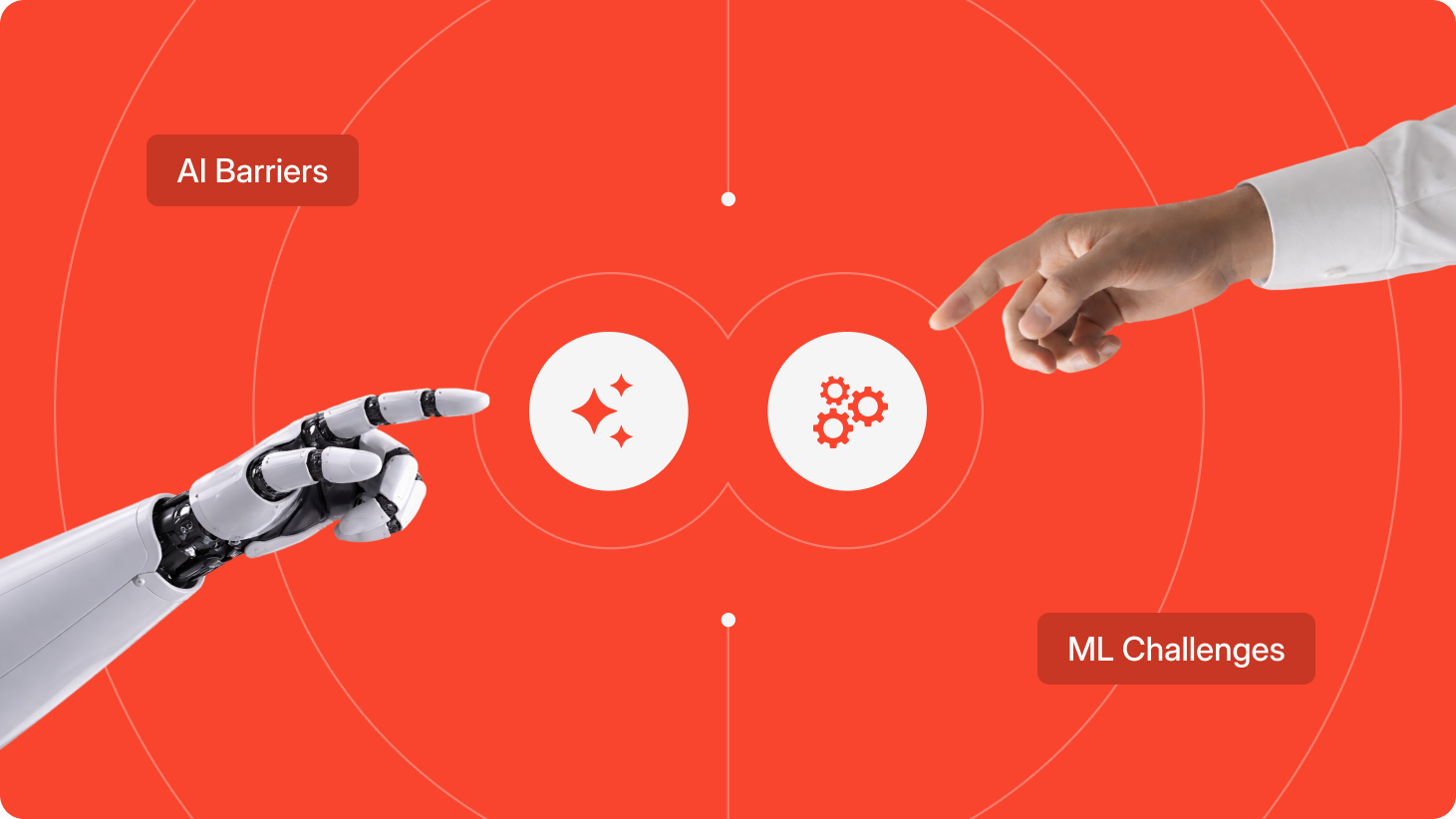
Artificial intelligence (AI) and machine learning (ML) are opening new opportunities for organizations. These technologies promise higher productivity, better decision-making, and significant innovation. However, implementing AI and ML also brings several challenges. This article explores ten common AI and ML implementation challenges and offers practical ways to overcome them.
Data quality and accessibility
According to a Gartner survey, poor data quality costs organizations an average of $15 million per year. In another Deloitte report, 65% of organizations reported challenges related to data accuracy when implementing AI and ML.
High-quality and accessible data remains one of the biggest barriers to successful AI adoption. Missing, inconsistent, or inaccurate data affects both model training and real-world performance. As a result, organizations need strong data management practices. These include cleaning and normalizing data, documenting sources, and ensuring teams can access the data they need.
Solution
Establish clear data governance standards. Clean, normalize, and document datasets thoroughly. Invest in data quality tools and use centralized repositories to create consistent, accessible data.
Lack of skilled talent
The World Economic Forum estimates that 85 million new roles may emerge by 2025 because of AI and automation. This rapid growth increases demand for professionals with AI and ML expertise.
Unfortunately, the supply of skilled talent still falls short. Many organizations struggle to recruit and retain AI specialists. This shortage makes it difficult to build and scale AI initiatives effectively.
Solution
Create a clear strategy for hiring and upskilling talent. Collaborate with universities, offer ongoing training, and encourage a culture of continuous learning. These steps help retain skilled professionals and strengthen internal AI capabilities.
Integration with existing systems
A study by McKinsey shows that integrating AI with existing processes is a challenge for 44% of AI adopters.
Many companies find it difficult to integrate new AI systems without disrupting current workflows. Existing infrastructure may not support AI tools, which creates delays and technical bottlenecks. Therefore, organizations must evaluate compatibility early and plan implementation phases carefully.
Solution
Assess your current systems before adopting new AI tools. Select solutions designed for compatibility and scalability. Introduce AI in phases to reduce disruption and ensure smooth integration.
Ethical considerations
A PwC survey found that 85% of CEOs expect AI to transform how they operate in the next five years, but many also worry about ethical risks.
Bias, privacy concerns, and lack of transparency raise important ethical questions. As AI systems grow more complex, organizations must evaluate how decisions are made and ensure fairness. Regular assessments help reduce potential bias and maintain user trust.
Solution
Establish ethical guidelines for integrating AI into business. Audit systems regularly to detect and correct biases. Maintain transparency to help users understand how AI makes decisions.
Cost of implementation
Deloitte reports that many organizations expect to invest between $500,000 and $5 million in AI initiatives, with 55% spending more than in previous years.
Developing AI solutions requires substantial time, expertise, and resources. Without proper planning, costs escalate quickly. A thoughtful financial strategy helps organizations manage investments while still moving forward.
Solution
Conduct a detailed cost-benefit analysis before starting any AI project. Explore artificial intelligence problems and solutions that fit your budget. Implement projects in stages to reduce upfront costs and demonstrate measurable value early.
Resistance to change
A Pegasystems study found that 72% of workers feel optimistic about AI’s impact on their tasks. Even so, resistance still exists due to fear, uncertainty, or limited understanding.
Employees may worry about job security or feel unsure about new processes. These concerns slow adoption and reduce productivity. Clear communication and supportive training help teams feel confident using AI tools.
Solution
Invest in change management programs that address employee concerns. Highlight AI’s benefits and involve teams in training. Reinforce how AI supports, rather than replaces, human expertise.
Regulatory compliance
An Ernst & Young survey revealed that 57% of executives view regulatory compliance as a major challenge when adopting AI.
AI regulations evolve rapidly, especially in highly regulated industries. Organizations must stay informed and adapt compliance practices proactively. Clear internal policies reduce risks and improve accountability.
Solution
Monitor AI-related regulatory changes regularly. Create transparent compliance guidelines and collaborate with regulators when needed.
Scalability
A BCG report found that 90% of organizations face challenges scaling AI beyond the pilot stage.
Scaling AI requires the right infrastructure, skilled teams, and ongoing optimization. Without these foundations, AI projects remain stuck in experimentation mode. Companies need a long-term plan to expand capabilities effectively.
Solution
Select AI tools that scale with your organization. Invest in flexible infrastructure that supports growing data volumes. Improve models continuously to maintain accuracy.
Security concerns
An MIT Technology Review Insights survey found that 60% of organizations see AI security as a major concern.
AI introduces new security risks, such as data breaches and model manipulation. Organizations must strengthen their cybersecurity posture to protect AI systems. Routine audits and secure authentication methods help mitigate risks.
Solution
Implement robust security practices, including strong authentication and routine audits. Train teams on AI-related threats and enforce strict data protection policies.
Measuring ROI and success
A NewVantage Partners study shows that 77% of companies struggle to extract meaningful insights from data, which makes evaluating AI success more difficult.
Organizations often lack clear metrics to measure AI outcomes. Without defined goals, AI projects may seem ineffective even when they add value. Consistent evaluation ensures alignment with business objectives.
Solution
Set measurable targets that support organizational goals. Incorporate these KPIs into AI monitoring processes. Review impact after implementation to determine ROI.
How can Brickclay help?
Businesses must adopt modern technologies to stay competitive. Machine learning (ML) enables organizations to automate processes, gain insights, and make data-driven decisions. Brickclay’s AI and machine learning services help companies address these challenges effectively.
Data preparation and optimization
AI projects rely heavily on high-quality data. Brickclay provides end-to-end data analysis and preprocessing services. These include cleaning, normalization, and feature engineering to prepare reliable training datasets.
Algorithm development and optimization
Our data scientists and ML engineers design and fine-tune algorithms tailored to your business needs. We work with both traditional models and advanced neural networks to achieve optimal performance.
System integration and deployment
We ensure seamless integration of AI and ML models into your existing systems. Whether you need AI for customer insights, fraud detection, or operational improvements, our team delivers smooth implementation.
Scalable and flexible ML solutions
Brickclay builds solutions that scale with your organization. As your business grows, our flexible infrastructure and model designs adapt with ease, ensuring continuous performance.
AI strategy and consulting
We help businesses identify high-impact AI opportunities and develop strategic roadmaps. This guidance ensures your AI initiatives align with long-term business goals.
Commitment to ethical AI
Ethical AI remains a priority at Brickclay. We work with organizations to address bias, promote transparency, and implement responsible AI practices.
By partnering with Brickclay, organizations gain a dedicated team focused on innovation and efficiency through AI. Contact us to learn how our machine learning solutions can support your business growth.

Brickclay



FAQ
Businesses struggle with data quality, talent shortages, integration issues, scalability barriers, and high costs. These common obstacles are part of broader AI implementation challenges for businesses.
Improving data quality requires strong governance, normalization, documentation, and accessible data pipelines. These practices strengthen overall AI data quality management for better model accuracy.
Limited availability of experienced AI and ML professionals slows development and scaling. A structured AI talent acquisition strategy helps bridge this skills gap.
Smooth adoption requires compatibility assessments, phased rollouts, and scalable tools. Following machine learning integration best practices ensures minimal disruption.
Ethical risks include bias, privacy issues, and transparency concerns. Clear guidelines and audits support responsible use through ethical AI implementation guidelines.
Conducting cost-benefit analysis, prioritizing high-impact use cases, and phased implementation help reduce expenses and support effective AI cost optimization methods.
Communication, training, and involving employees in AI decisions improve adoption. These measures reinforce a strong machine learning project roadmap.
Staying updated on evolving regulations, documenting processes, and conducting compliance audits help organizations address AI system security challenges while meeting legal requirements.
Scaling requires robust infrastructure, ongoing optimization, and repeatable deployment frameworks—core parts of a solid AI scalability solutions framework.
Setting clear KPIs, tracking performance, and reviewing business impact ensures accurate evaluation supported by measuring AI implementation success.

Your Data is Scattered. Your Decisions Shouldn't Be.
Unified data pipelines, warehouses, and lakes built for scale.
Build Your Data Foundation