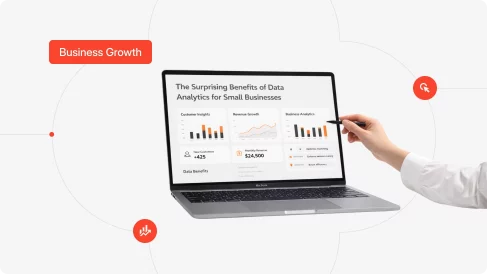





Business Intelligence (BI) technologies help companies stay competitive by offering a unified view of essential data. Recent studies suggest that business intelligence tools will continue to expand, reaching more than 50% of all firms by 2023.
With the help of business intelligence, organizations can identify patterns and anticipate future trends. When teams gain access to reliable information, they can develop strategies that enhance products, improve services, and boost performance. Many companies around the world now use data and analytics to:
- Improve productivity and reduce expenses (60%)
- Adjust strategies and initiatives (57%)
- Optimize financial outcomes (52%)
- Understand customer behavior (51%)
- Mitigate risks (50%)
- Increase sales and strengthen customer loyalty (49%)
Organizations that have not adopted BI analytics services may miss out on meaningful advantages. Brickclay provides managed BI services that help companies gain insights through Power BI dashboards.
Although the service is still evolving, it already shows strong potential for organizations that want to improve how they prepare, analyze, visualize, and interpret data.
Business intelligence process
Strong questions and clear goals guide every organization. Teams gather and evaluate data to address these questions and track progress toward objectives.
On the technical side, raw data comes from enterprise systems. It is stored and processed across data centers, applications, cloud environments, and internal files. Once users gain access to structured information, they can begin analytical work to answer key business questions.
Many BI platforms also offer data visualization features. These tools turn raw information into charts and graphs that help stakeholders make informed decisions.
BI methods
Business intelligence includes a wide range of methods that support the gathering, storing, and analyzing of information. Together, these methods offer a complete view of a company and highlight new opportunities for improvement.
BI continues to evolve and now incorporates advanced techniques that help teams enhance productivity. Common BI methods include:
- Data mining: exploring large datasets with databases, statistics, and machine learning.
- Reporting: sharing analytical results with stakeholders so they can take action.
- Benchmarks and performance tracking: comparing actual performance with historical targets using dashboards.
- Querying: extracting insights by asking targeted, data-centered questions.
- Statistical analysis: exploring why trends occur using statistical techniques and descriptive analytics.
- Data visualization: turning analytical findings into charts, graphs, and histograms.
- Visual analysis: using interactive visual tools to explore insights in real time.
- Data preparation: gathering information from multiple sources and organizing it for analysis.
How BI, data analytics, and business analytics work together
Data analytics and business analytics form key parts of a business intelligence framework, and teams rarely use them independently. BI helps people interpret data, while data science techniques uncover patterns and generate predictions through statistical and predictive models.
Data analysis answers questions such as “Why did this happen?” and “What should we do next?” Business intelligence then transforms those findings into practical insights. According to Gartner’s IT lexicon, business analytics includes data mining, predictive analytics, applied analytics, and statistics. In short, business analytics supports a company’s broader BI strategy.
BI enables quick analysis and supports day-to-day decision-making. Meanwhile, analytics deepens understanding by exploring follow-up questions that lead to continuous learning.
Together, these processes create a cycle of accessing data, discovering insights, exploring new questions, and sharing knowledge with stakeholders.
How to create a plan for business intelligence
A BI strategy outlines how a company will use data to achieve its goals. In the early stages, teams define their data strategy, identify key contributors, and assign responsibilities. Clear business objectives play an essential role in setting the right direction.
A strong BI plan typically includes steps such as:
- Understanding the company’s long-term objectives
- Identifying key stakeholders
- Selecting an executive sponsor
- Choosing the right BI tools and platforms
- Creating a team to manage BI initiatives
- Defining the project scope
- Preparing the data infrastructure
- Setting measurable objectives and building a roadmap
Business analytics tools
BI tools support data collection, processing, and analysis. They also help teams build reports, dashboards, and performance scorecards. Many BI platforms include online analytical processing (OLAP), predictive analytics, and enhanced analytics capabilities.
Earlier BI systems primarily focused on querying and reporting. Modern platforms offer far greater capabilities and enable faster, more informed decision-making through interactive dashboards and real-time insights.
Spectrum of business intelligence tools
Today’s BI tools offer a wide range of customization features. Organizations often explore several categories before selecting the right fit.
Directional analyses
Directional analytics enhances business intelligence, and records management services provide the foundation needed to support this capability. These services create a reliable structure for storing documents, which helps teams conduct deeper research in a more organized environment.
Self-service analytics
Self-service analytics becomes possible when supported by an enterprise data warehouse. This centralized data repository brings information from multiple sources together, allowing teams to quickly uncover insights and make informed decisions.
Embedded analytics
Embedded analytics has become more accessible with solutions like Power BI. These tools enable organizations to integrate reporting, visualization, and exploration features directly into their applications and workflows.
When organizations choose BI software that aligns with their needs, they gain the ability to make informed decisions and improve business performance. Every choice should support long-term growth and operational improvement.
Top business intelligence tools for data analysis
Today, organizations can choose from a wide range of BI tools. Many independent reviews highlight the following platforms as the most frequently recommended options.
Power BI
This cloud-based tool integrates with spreadsheets, databases, and cloud applications to support real-time analysis and reporting. It also offers mobile access, allowing users to review data on the go.
Tableau
The Tableau platform is widely used across different industries. Its drag-and-drop interface enables users to build visual insights without deep technical knowledge. Teams can connect to spreadsheets, databases, and cloud sources with ease.
QlikView
QlikView is known for its strong data security and accuracy. It offers both simple reports and advanced analytics and includes self-service features through a user-friendly, drag-and-drop interface.
Sisense
Sisense supports the full data analysis process, including ETL, analytics, and visualization. Its In-Chip database engine improves performance, while built-in machine learning features help teams uncover deeper insights.
Yellowfin
Yellowfin offers cloud-based BI capabilities, strong visualizations, and collaboration tools. Its no-code and low-code development features allow teams to build dashboards quickly, even without programming experience. Dashboards are accessible through mobile devices and web applications.
How can Brickclay help?
Business intelligence technologies continue to transform how organizations analyze and use data. Each platform has unique strengths, and the best choice depends on your business needs.
Brickclay helps companies turn raw data into meaningful insights that support critical decisions. Our clients gain access to powerful tools that enable efficient data exploration and allow them to address challenges with confidence.
Contact us to learn how Brickclay can strengthen your data initiatives.

Brickclay



FAQ
The BI landscape in 2025 includes Power BI, Tableau, QlikView, Sisense, and Yellowfin offering reporting, dashboards, predictive analytics, and cloud capabilities.
BI centralizes data into actionable insights, helping organizations analyze performance, track KPIs, and forecast trends for strategic decisions.
BI focuses on dashboards and real-time insights, while data analytics uses statistical models to explain trends and forecast outcomes.
Power BI integrates with databases and cloud apps, offering interactive dashboards, automation, and real-time reporting for fast insights.
Tableau and QlikView provide intuitive dashboards to track sales, monitor operations, understand customers, and optimize performance without advanced skills.
A BI strategy includes defining goals, selecting stakeholders, choosing tools, preparing data infrastructure, and setting measurable KPIs.
Sisense uses built-in machine learning to detect patterns, automate predictions, and accelerate analysis for deeper insights.
Yellowfin offers drag-and-drop dashboards, visualization, and collaboration tools without programming, ideal for fast no-code BI deployment.
Managed BI services handle data prep, dashboard creation, and optimization, providing ready-made dashboards for faster insights and decisions.
Future BI trends include real-time dashboards, AI analytics, self-service BI, embedded analytics, and cloud reporting for faster, data-driven decisions.

From Raw Data to
AI-Powered Decisions.
Pipelines, ML models, and dashboards, the complete data-to-intelligence stack.
Talk to Our Data Team