




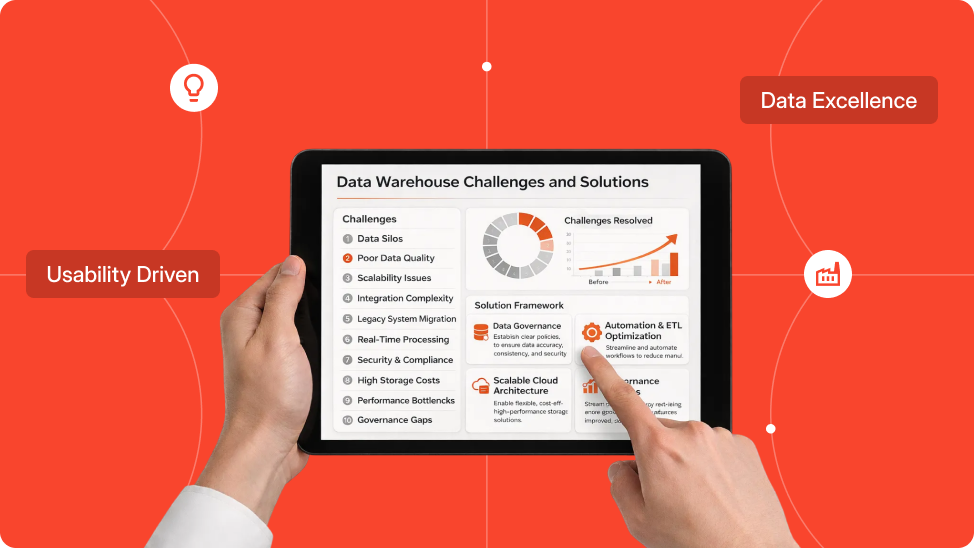
In the growing field of data engineering services, the importance of data warehouses cannot be overstated. Data warehouses serve as the foundation for strategic decision-making, enabling organizations to harness information as a powerful asset. However, with these capabilities come challenges. This guide provides insights into the top 10 current business problems related to strategic data warehousing, with a focus on data quality governance. The content is designed for higher management, chief people officers, managing directors, and country managers.
Role of data warehousing
Information management
Information Resource Management (IRM) aims to minimize redundant operational data and organize it to support organizational objectives. Effective warehouses require clear standards for naming, data mapping, and database construction. These standards must be developed and communicated before creating the warehouse. Without clearly defined operational data, systems administrators cannot retrieve information efficiently, and end users may lose trust in the warehouse outputs. IRM requires dedicated personnel to manage information, particularly when contractors assist in developing and maintaining corporate repositories.
Database architecture
Database architects oversee the physical design and administration of the warehouse. They represent entities during the modeling process and supervise table development. Senior analysts monitor changes made by junior analysts and ensure proper maintenance. Their strength lies in visualizing the structure and functionality of the warehouse to support both operational and analytical requirements.
Repository administration
A centralized repository is essential for managing metadata, which includes information about data sources, planned transformations, formats, and purposes. It typically contains data models and procedures, serving as a single reference point during development. Managing a repository requires two complementary roles: a data-focused administrator and a database-savvy professional. The repository administrator integrates operational and warehouse models and acts as a bridge between technical teams and end users.
Analysis of business area needs
Data warehouse analysis helps identify the analytical processes and data required for decision-making. Business representatives and IRM teams collaborate to define the warehouse requirements. Key questions include: What information is needed from analytical channels? Which processes generate this data? How will it support decisions? A meeting facilitator ensures efficient discussion, saving time and energy while capturing all necessary details.
Data analysis
Operational and informational systems modeling share similar techniques but yield distinct models. Operational models are detailed and optimized for transactions, while informational models are simplified for analysis. Both models are essential and should be integrated into system development plans. Using operational data as a foundation, informational models fulfill analytical needs. Teams construct and validate these models by transferring data between operational and warehouse systems. For more information, see data engineering services.
Data warehouse challenges and solutions
Data quality concerns
Gartner estimates that poor data quality costs organizations an average of $15 million per year. High-quality data is essential for accurate analysis and reliable decision-making. Inconsistent or inaccurate information erodes trust in the warehouse.
Solution
Organizations should implement robust governance practices, including data profiling, cleansing, and validation. Maintaining high accuracy and reliability builds stakeholder trust and sets clear expectations for acceptable data quality.
Scalability issues
The cloud-based data warehousing market is expected to grow at a CAGR of over 22.3% from 2020 to 2025. Traditional on-premise warehouses often struggle to scale, leading to performance bottlenecks and higher costs for hardware upgrades.
Solution
Cloud-based data warehouses provide elasticity, allowing organizations to scale resources on demand. This approach addresses performance issues and offers cost efficiency by charging only for used resources.
Integration complexities
A survey found that 94% of IT decision-makers face data integration challenges. Diverse sources with varying formats complicate consolidation into a unified warehouse.
Solution
Using data integration tools and middleware ensures smooth ETL processes. These tools harmonize data from multiple sources, enhancing efficiency and accuracy.
Data security and privacy
IBM reports the average cost of a data breach at $3.86 million, a 15% increase over three years. Protecting sensitive data from breaches and regulatory non-compliance is critical.
Solution
Organizations should implement strong encryption, strict access controls, and robust security protocols. Compliance with GDPR, HIPAA, and other regulations reduces legal and reputational risks.
Lack of data governance strategy
Collibra found that 87% of organizations consider data governance critical. Without a strategy, data management becomes inconsistent, and accountability suffers.
Solution
Develop a comprehensive governance framework with clear policies and stewardship responsibilities. This ensures all users understand their role in managing data throughout its lifecycle.
Performance tuning challenges
Over 80% of data professionals report performance issues in data warehouses. Poorly tuned databases can slow queries and hinder real-time analytics.
Solution
Regular performance tuning, query optimization, indexing, and partitioning improve efficiency. Understanding user access patterns ensures faster and more reliable results.
Meeting business requirements
Only 40% of organizations feel their warehouses consistently deliver business value. Static warehouses may fail to meet evolving needs.
Solution
Establish communication between business and technical teams. Regularly review requirements and adjust specifications to ensure the warehouse remains aligned with business objectives.
Data warehouse strategy alignment
Nucleus Research reports that companies aligning data strategy with business goals achieve a 23% increase in ROI. Misalignment can reduce the strategic value of data.
Solution
Ensure the warehouse strategy aligns with overall business goals. This fosters a data-driven culture and maximizes the strategic impact of information.
Adoption and user training
Organizations investing in employee training see 24% higher profit margins. Lack of training limits adoption and reduces warehouse effectiveness.
Solution
Comprehensive user training ensures stakeholders understand and effectively utilize the warehouse, increasing adoption and maximizing value.
Cost management
Forbes reports that organizations spend about 7.6% of IT budgets on data warehousing. Balancing performance and costs is critical.
Solution
Cloud solutions offer flexible, scalable infrastructure. Periodic reassessment ensures costs remain aligned with budget while meeting performance needs.
How can Brickclay help?
Brickclay, a leading provider of data engineering services, helps organizations navigate the top data warehousing challenges through customized solutions:
- Data quality governance: We design and maintain robust governance practices to ensure accuracy and reliability of warehouse data.
- Cloud-based solutions: Brickclay implements scalable cloud warehouses to prevent bottlenecks and support growing data demands.
- Integration complexities: Our experts integrate multiple data sources using advanced tools and middleware for seamless data flow.
- Data security and privacy: We enforce strong security protocols, encryption, and access controls to protect sensitive data and ensure compliance.
- Data governance framework: Brickclay develops comprehensive governance frameworks, clarifying policies, procedures, and responsibilities.
- Performance optimization: We enhance warehouse efficiency through indexing, partitioning, and caching techniques.
With Brickclay’s expertise, organizations can transform data warehousing challenges into opportunities for growth and innovation. Our tailored data engineering solutions empower businesses to maximize the value of their data. Contact us today to start optimizing your data management and warehouse strategy.