




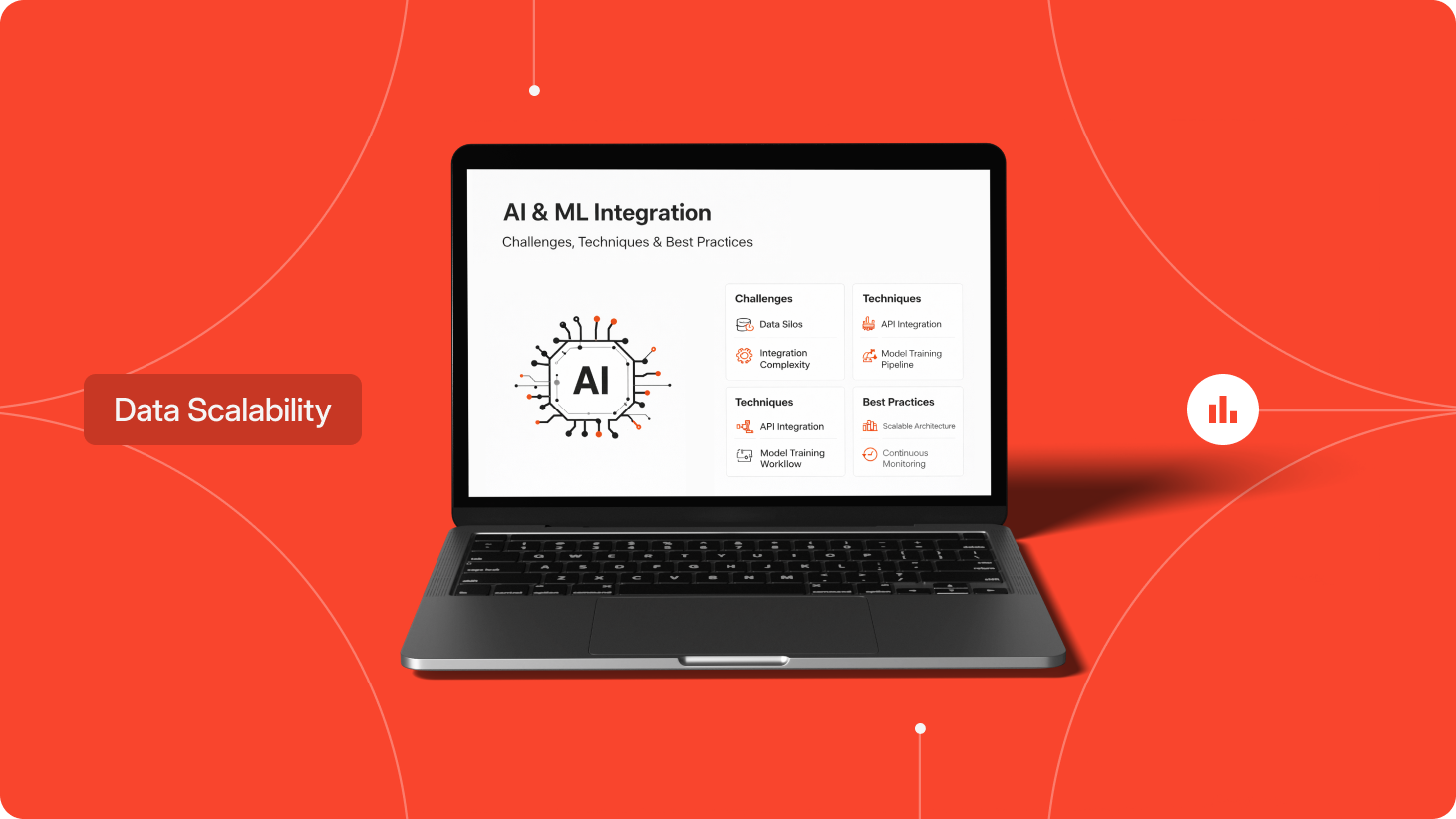
Companies today rely on Artificial Intelligence (AI) and Machine Learning (ML) to utilize the full potential of their data. These technologies enhance decision-making, automate routine tasks, and reveal actionable insights. However, organizations must address several AI and ML integration challenges before they can realize these benefits.
AI and ML offer opportunities to elevate customer experiences, support leadership decision-making, and improve operational efficiency. Despite these advantages, companies must overcome a series of obstacles to integrate these technologies successfully.
This article explores the key challenges, integration techniques, and best practices for AI and ML adoption. It also highlights how Brickclay’s expertise in data engineering and analytics can guide organizations through this transformation.
Navigating the AI and ML landscape
The World Economic Forum estimates that AI will disrupt 85 million jobs worldwide between 2020 and 2025 while creating 97 million new ones. As many as 40% of the global workforce will need new skills within the next three years.
Given this shift, organizations across sectors now rely on AI and ML to turn data into strategic value. These technologies power predictive analytics, enhance personalization, and support automation. Even so, AI and ML adoption continues to present notable barriers.
Challenges in integrating AI and ML techniques
Data quality and accessibility
AI and ML rely on clean, consistent, and complete data. Missing values, errors, and inconsistencies often reduce model accuracy and limit system performance.
Data privacy and security
As regulations evolve, organizations must ensure that AI and ML systems comply with strict data protection requirements. This responsibility demands careful oversight and secure practices.
Resource constraints
Many companies struggle to secure the computing power required to train and deploy ML models. High infrastructure costs often slow or limit adoption.
Lack of skilled talent
Companies continue to face shortages of experienced AI, data, and ML professionals. Recruiting and retaining skilled teams remains a significant challenge.
Integration with existing systems
Integrating AI and ML with legacy systems often introduces complexity. Organizations must ensure that new solutions align with existing workflows and infrastructure.
Interoperability
AI and ML solutions must work smoothly with current tools, platforms, and data systems. Achieving interoperability supports efficient implementation and long-term scalability.
Because every organization faces these challenges differently, leaders must approach AI and ML integration with flexibility and clarity. Addressing these hurdles early allows companies to adopt AI more confidently and unlock broader value.
Techniques for successful AI and ML integration
Optimized data preprocessing
Strong data preparation improves the reliability of AI and ML models. Techniques such as feature engineering, standardization, and data wrangling help create high-quality training datasets.
Strategic algorithm selection
Choosing the right algorithms—such as neural networks, clustering methods, or regression models—ensures that ML solutions address specific business problems effectively.
Effective model training
Robust model training requires extensive data and techniques like cross-validation and ensemble learning. These practices improve accuracy and support measurable performance gains.
Leveraging automated machine learning (AutoML)
AutoML tools simplify model development and deployment. They make AI and ML adoption more accessible for teams with limited technical expertise.
Enhancing transparency with explainable AI (XAI)
Explainable AI helps organizations understand how models generate decisions. As a result, businesses build trust, reduce risk, and improve accountability.
Continuous model monitoring and maintenance
AI and ML models evolve over time. Regular monitoring allows teams to detect performance decline and make timely adjustments.
Best practices for AI and ML integration
- Start with a clear strategy aligned with business goals. A well-defined plan ensures that AI and ML initiatives deliver meaningful outcomes.
- Invest in strong data quality and governance to maintain reliable inputs for ML models.
- Encourage collaboration among data science teams, IT units, and business leaders to ensure practical and sustainable solutions.
- Promote continuous learning since AI and ML innovation advances rapidly.
- Experiment frequently and iterate based on performance data to refine outcomes.
- Follow ethical and regulatory requirements to protect user privacy and reduce bias.
- Plan for scalability early so that AI and ML systems can expand with business needs.
Real-world impact
AI and ML adoption continues to reshape industries by improving decision-making, streamlining processes, and elevating customer experiences. The following examples show how these technologies deliver measurable results across key sectors.
Healthcare
The global market for AI and ML in medical diagnostics is projected to reach $3.7 billion by 2028, with a CAGR of 23.2%. This growth reflects the industry’s increasing reliance on AI-driven diagnostics and patient care solutions.
- AI-powered diagnostic tools improve accuracy by analyzing medical images and identifying abnormalities quickly.
- ML models support drug discovery by predicting interactions and identifying promising candidates faster.
- AI-supported virtual assistants enhance patient engagement and help clinicians personalize care plans.
Finance
Fintech innovations may generate more than $1 trillion in cost savings. Traditional institutions could reduce operational expenses by 22% by 2030 through AI adoption.
- ML-based fraud detection systems analyze transactions in real time and protect customers from financial risk.
- AI-driven trading algorithms process market data instantly to optimize trading strategies.
Marketing and e-commerce
The AI retail market is set to reach $15.3 billion by 2025 as companies increase adoption for personalization and operational efficiency.
- AI helps retailers deliver personalized product recommendations and relevant content.
- Predictive analytics supports inventory planning and targeted marketing.
- AI-driven chatbots improve customer interactions and reduce response times.
Manufacturing
AI in manufacturing is projected to grow from $3.2 billion in 2023 to $20.8 billion by 2028 due to advancements in automation and IoT technologies.
- AI-driven predictive maintenance prevents equipment failures and reduces downtime.
- Supply chains run more efficiently with AI-supported forecasting and demand planning.
Agriculture
Precision agriculture continues to expand, with a projected CAGR of over 13% through 2028. AI now plays a major role in resource optimization and crop management.
- AI-driven sensors and imaging tools help farmers monitor soil health, crop growth, and irrigation needs with greater accuracy.
Transportation
AI-enabled traffic management could help the global intelligent traffic systems market reach $10.94 billion by 2025.
- AI supports self-driving vehicles by helping them interpret surroundings and respond safely.
- AI-optimized route planning helps reduce congestion and improve fuel efficiency.
These examples reflect only a portion of what AI and ML can achieve. As adoption increases, industries will continue to discover new opportunities for innovation and growth.
How can Brickclay help?
AI and ML integration services
Brickclay provides comprehensive machine learning services to support AI and ML adoption. Our engineers specialize in data preparation, model development, system integration, and workflow automation.
Strategic consulting and ethical guidance
We also help organizations define their AI and ML strategy, establish governance frameworks, and ensure compliance with data privacy and ethical standards.
End-to-end transformation support
With our expertise in data engineering and analytics, we guide companies through every stage of AI and ML implementation. This approach helps businesses reduce risk, unlock value, and scale more efficiently.
As AI and ML continue to evolve, organizations that embrace these technologies will gain a competitive edge. By addressing key challenges and adopting proven integration techniques, businesses can create long-term impact and accelerate digital growth.
Contact us to explore how Brickclay can help your organization harness AI and ML for smarter decision-making and sustainable expansion.