




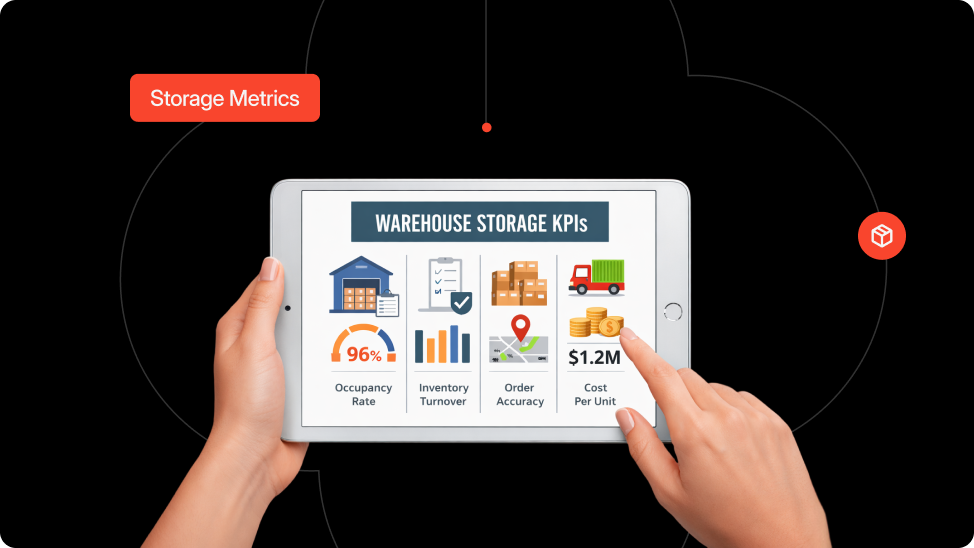
Warehouse KPIs are performance measurements that enable managers and executives to assess how successfully a team, project, or organization is performing. As part of a broader strategy or a way to align efforts toward a common goal, KPIs are not an end in themselves but a means of gauging progress. Key performance indicators (KPIs) can be broad in scope or focused on a specific metric or process.
Effective resource management is crucial to a company’s success in today’s dynamic business environment. As a vital part of resource management, warehouse storage requires constant vigilance. Research from the National Retail Federation reveals that companies with an inventory accuracy rate of 95% or higher experience an impressive 10% increase in their net profit margins.
In this article, we will discuss the most successful storage KPIs for warehouse management that any company can implement. Brickclay, an industry leader in business intelligence (BI) and warehouse storage management, walks you through the 10 KPIs that have proven most useful in optimizing your storage space.
Key storage performance metrics
Inventory accuracy
Maintaining an accurate inventory is vital to running a smooth storage facility. This key performance indicator assesses how well digital stocktake corresponds to the real thing. If the inventory counts are spot on, the company won’t have to worry about running out of stock or having too much of a good thing.
[highlighttext text=center]Formula: (number of accurate inventory counts / total number of inventory counts) x 100[/highlighttext]
A recent study found that companies with high inventory accuracy rates (above 95%) experience a 20% reduction in carrying costs and a 98% order accuracy rate.
Fill rate
The “fill rate” measures the percentage of orders fulfilled from in-stock items without backorders. A high fill rate shows that the warehouse manages inventory efficiently and keeps customers satisfied, whereas a low fill rate indicates that stock levels are insufficient or warehouse operations are inefficient.
[highlighttext text=center]Formula: (number of orders shipped complete / total number of orders) x 100[/highlighttext]
A Retail Systems Research (RSR) report shows that retailers with high fill rates saw a 5.9% increase in revenue compared to those with lower fill rates.
Order picking accuracy
This key performance indicator tracks how accurately warehouse staff pick items for shipment according to the customer’s order. By reducing picking errors and saving time, companies can boost customer confidence and lower the rate of returns.
[highlighttext text=center]Formula: (number of accurate picks / total number of picks) x 100[/highlighttext]
A study published in the International Journal of Engineering and Applied Sciences indicated that order picking accuracy levels above 99% significantly reduce labor costs associated with correcting picking errors.
Storage space utilization
When managed efficiently, storage space may be put to its full potential. This key performance indicator assesses how successfully businesses and individuals use warehouse space, which can help avoid unnecessary waste and the early construction of new warehouses.
[highlighttext text=center]Formula: (total used storage space / total available storage space) x 100[/highlighttext]
Research conducted by the Warehousing Education and Research Council (WERC) found that optimizing storage space utilization can lead to a 10-20% reduction in warehouse operations costs.
Order cycle time
The “order cycle time” measures the duration between placing an order and fulfilling it. Shortening order processing times boosts customer satisfaction and increases productivity. Efficiently managing warehouse space also helps speed up fulfillment.
[highlighttext text=center]Formula: (order delivery date – order receipt date)[/highlighttext]
In a survey by the Council of Supply Chain Management Professionals (CSCMP), 99% of supply chain professionals agreed that reducing order cycle times is a top priority for improving customer satisfaction and operational efficiency.
Cost per unit stored
To control storage costs effectively, managers must track how much it costs to store each item. These records management performance metrics help identify opportunities to cut expenses, such as by using storage space more efficiently.
[highlighttext text=center]Formula: total storage costs / total number of units stored[/highlighttext]
A report by Deloitte on supply chain cost reduction strategies highlighted that understanding the cost per unit stored is essential for identifying opportunities to reduce warehousing expenses.
Stock turnover rate
The stock turnover rate tracks how quickly warehouse stock sells and is replenished over a given time frame. Products with a high turnover rate move rapidly through the warehouse, reducing storage costs and lowering the risk of obsolescence.
[highlighttext text=center]Formula: cost of goods sold (COGS) / average inventory value[/highlighttext]
The Harvard Business Review noted that companies with higher stock turnover rates tend to have lower carrying costs and better cash flow, which can lead to increased profitability.
Deadstock percentage
Deadstock refers to inventory that remains unused for an extended period. By tracking the percentage of deadstock, businesses can decide whether to discount, repurpose, or remove products from storage.
[highlighttext text=center]Formula: (number of deadstock items / total number of inventory items) x 100[/highlighttext]
A recent case study found that reducing deadstock by just 10% can result in significant cost savings and increased warehouse efficiency.
Dock-to-stock time
Dock-to-stock time measures how quickly goods move from the dock to the warehouse. Shortening this time reduces congestion and maximizes product availability for order fulfillment.
[highlighttext text=center]Formula: (time products spend in receiving – time products spend in storage)[/highlighttext]
Research conducted by the Georgia Tech Supply Chain and Logistics Institute emphasized the importance of reducing dock-to-stock times to manage just-in-time inventory and minimize storage costs.
On-time shipments
On-time shipments measure the percentage of orders fulfilled within the estimated time frame. This key performance indicator evaluates the reliability of inventory and distribution processes and directly influences customer satisfaction.
[highlighttext text=center]Formula: (number of on-time shipments / total number of shipments) x 100[/highlighttext]
A study by Accenture on supply chain performance found that companies with a high percentage of on-time shipments (above 95%) tend to have higher customer satisfaction scores and repeat business.
Importance of warehousing storage and business intelligence
Monitoring and managing storage key performance indicators requires sophisticated data analysis and reporting tools. Data warehousing and business intelligence solutions provide the capabilities needed to track and optimize these metrics effectively.
Business intelligence tools, such as those offered by Brickclay, allow companies to:
- Combine information from multiple systems, including stock-control software and warehouse automation devices.
- Create reports and dashboards to track key performance indicators in real time.
- Apply advanced analytics to identify patterns, outliers, and growth opportunities.
- Use data to make informed decisions and optimize warehouse inventory management.
Scalable Azure warehouse storage solution
Companies with massive amounts of data to store will find Azure data warehouse storage a scalable and inexpensive option. Azure’s cloud-based infrastructure allows businesses to expand storage easily as they grow, ensuring that data warehousing needs are always met.
How can Brickclay help?
Effective resource management is crucial for any company’s success, particularly in warehousing. By establishing and monitoring these 10 key performance indicators (KPIs), businesses can optimize storage operations, reduce costs, increase customer satisfaction, and stay ahead of the competition.
To fully leverage these KPIs, businesses need business intelligence and data warehousing management solutions. Access to real-time data collection, analysis, and visualization makes it easier to make smarter, more profitable storage management decisions. By adopting these strategies and technologies, upper management, chief people officers, managing directors, and country managers can position their organizations for success in the dynamic world of resource management.
Contact Brickclay for guidance, and ensure your storage operations are optimized and ready for the future.